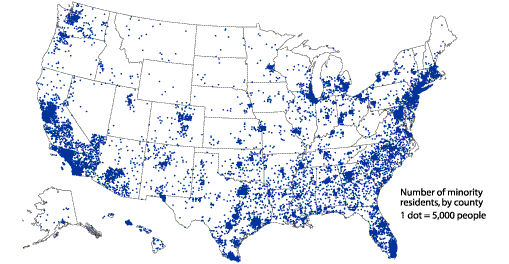
The Geography of Diversity in the U.S.(AmeriStat, June 2001) During the 1990s, the combined population of African Americans, Native Americans, Asians, Pacific Islanders, and Hispanics/Latinos in the United States grew at 13 times the rate of the non-Hispanic white population. Some say that this signals an impending power shift and the transition to a truly multicultural nation. But growth rates are only part of the story. Non-Hispanic whites still make up 69 percent of the U.S. population. More significantly, in 16 states and more than half of U.S. counties (1,822 out of 3,141), non-Hispanic whites account for at least 85 percent of the population. In three states — Maine, Vermont, and New Hampshire — non-Hispanic whites account for more than 95 percent of the population. Hawaii, New Mexico, and California are the only states that are less than 50 percent non-Hispanic white. While non-Hispanic whites are distributed throughout the country, minorities are much more clustered. More than half (51 percent) of minorities live in just five states: California, New York, Texas, Florida, and Illinois. These are not, however, the states with the highest concentrations of minorities. For example, Hawaii has the highest percentage of Asian Americans (41 percent), the District of Columbia has the highest percentage of blacks (59 percent), Alaska has the highest concentration of American Indians (15 percent), and New Mexico has the highest percentage of Hispanics (42 percent). While non-Hispanic African Americans make up 12 percent of the total U.S. population, they account for 10 percent or less of the populations in New England, the Midwest, the Mountain West, and the Pacific coast. Numerically, New York has the largest population of non-Hispanic blacks (2.8 million); Montana has the smallest (2,500). The largest population of Asians reside in California (3.6 million), and Oklahoma houses the largest population of American Indians (266,000). Hispanics are concentrated in high-immigration gateway cities such as Los Angeles, New York City, and Miami. They are also concentrated throughout the Southwest states. There are relatively large Hispanic populations in Texas (6.7 million), New York (2.9 million), and Florida (2.7 million); Illinois, Arizona, and New Jersey also have more than 1 million Hispanics each. But California has the largest Hispanic population by far, with almost 11 million — nearly one of every three Americans of Hispanic/Latino origin. Distribution of U.S. Minorities, 2000
Source: U.S. Census Bureau. Distribution of U.S. Minorities by County, 2000 Source: U.S. Census Bureau. CitationsAnalysis of data from the U.S. Census Bureau. Related LinksU.S. Census Bureau: Census 2000 |