| Educational Highs and Lows Among the Foreign-Born
Public policy initiatives often stress education as a means of guaranteeing a well-paid, productive population. In general, a person with a college degree earns more money and has more employment opportunities than a person with only a high school degree or less.
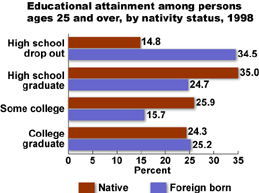
This is of particular concern to immigrant communities. The adjacent graph shows the
educational attainment of native- and
foreign-born persons. It shows that persons born in the United States are more than twice as likely to have completed high school compared with the foreign-born. In contrast, the percentage of native- and foreign-born persons with college degrees is almost identical; in fact, foreign-born persons are slightly more likely to have college degrees. This reveals a dichotomy in the immigrant community: One group is highly skilled and college educated, and can expect to compete with native-born persons for well-paying jobs; while the other group consists largely of less educated migrant workers.
This dichotomy among the foreign-born is evident when we compare educational attainment among persons of Hispanic and Asian descent. More than 40 percent of Asians finished four years of college, compared with only 11 percent of Latinos. Hispanics are about twice as likely as blacks and three times more likely than whites to drop out of high school.
|