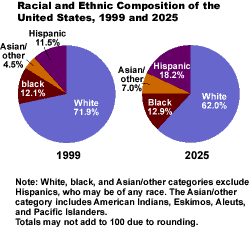
Racial and ethnic diversity has always been a hallmark of American society. Immigration from different parts of the world, and the different fertility and mortality rates among recent migrants, have kept the racial and ethnic composition in flux. African Americans are currently the largest minority in the United States, accounting for 12.1 percent of the population. About 11.5 percent of persons classify themselves as Hispanic; 3.8 percent are Asian or Pacific Islander; and less than 1 percent are American Indian or Alaska Native. The majority of the U.S. population, about 72 percent, is white.
Because of their relatively high migration and fertility
rates, Hispanics are projected to outnumber blacks early in the 21st century. By 2025, Hispanics will account for 18 percent of the U.S. population, while only 13 percent of the population will be African American. Over the same period, the percentage of whites will decline by ten percentage points, to 62 percent. If current trends continue, almost half of the U.S. population will be non-white by 2050.
Over the next 25 years, minority concentrations are projected to increase in all parts of the country, but especially in the South, Southwest, and West. By 2025, minority groups are expected to account for over 50 percent of the population in four states (Hawaii, California, New Mexico, Texas) and the District of Columbia.