Two common measures of fertility are the crude birth rate and the total fertility rate. The crude birth rate represents the number of births in a given year per 1,000 people in the total population at midyear. The total fertility rate is a cumulative measure of separate fertility rates for women of different ages in a given year. In 1999, the total fertility rate was 2.1, which means that a woman or group of women would be expected to have two children, on average, by the time they reached the end of their childbearing years. The crude birth rate is useful as a general measure of fertility, but demographers generally prefer the total fertility rate because it takes into account the age structure of the population. For example, the total fertility rate makes it possible to compare a population that has a high proportion of women in older age groups, which will naturally tend to have fewer births, with a population that has a high proportion of women of reproductive age.
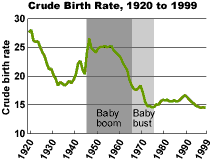
The crude fertility rate fell steadily during the 1920s, and bottomed out in the 1930s during the Great Depression. It began to rise again during the more prosperous war years, and then reached a plateau at around 25 births per 1,000 people during the post-war baby boom. Since then the crude birth rate has fallen to its current (1999) level of 14.5 births per 1,000 people. The absolute number of births in the United States reached a record high in 1957, when 4.3 million babies were born. In 1999 there were 4 million births.
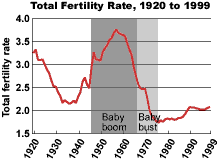
The total fertility rate and crude birth rate followed similar paths prior to World War II and then diverged, with a much more pronounced peak in the total fertility rate during the baby boom. The total fertility rate rose to almost 3.8 in 1957, a level not seen in the United States since the earliest years of the 20th century. Women born between 1931 and 1935, who were in their 20s at the height of the baby boom, averaged 3.2 children per woman, making them the most prolific recent generation of American women. In the 1960s, fertility rates resumed their decline and have remained at relatively low levels.