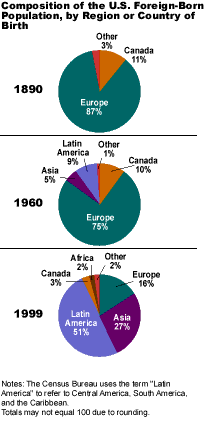
Prior to the mid-20th century, immigrants came primarily from northwestern European countries — Great Britain, Ireland, Germany, Scandinavia, France — and from Canada. In 1890, 86 percent of foreigners in the United States were from European countries, and 11 percent arrived from Canada. By 1960, the composition of the foreign-born population had changed slightly, because of new waves of immigration from different parts of the world. About 75 percent of the foreign-born population originated from Europe, 10 percent from Canada, 9 percent from Latin America, and 5 percent from Asia.
By 1999, there had been a dramatic shift in the country of origin of the U.S. foreign-born population. Over half of the foreign-born population originated from Latin America (51 percent), 27 percent from Asia, and only 16 percent from Europe. Canada accounted for 3 percent of the foreign-born population, and Africa for 2 percent.
These shifts in patterns of immigration have resulted in a much more racially and ethnically diverse foreign-born population. In 1890, only 1.4 percent of the foreign-born population was nonwhite. By 1970, 27 percent of foreigners were nonwhite, and by 1999, 75 percent were nonwhite.