What are �female-headed� households? Most
studies consider them to be households in which there is no adult
male, or households in which adult males rely on the female
breadwinner for support, such as an adult child of a single mother.
�Female-headed� does not mean that the woman earns more money
(which is the case in only a quarter of households) or is responsible
for the family finances. In fact, women and children in female-headed
households are more likely to live in poverty than women and children
in most other household situations, where there are more potential
workers.
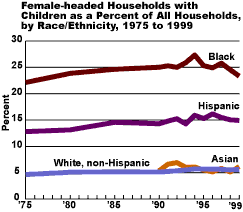
In the graph on this page, a female-headed
household with children is a special type of female-headed
household in which the household head lives with one or more related children.
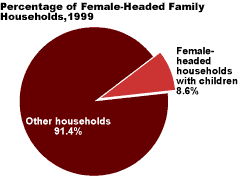
About 9 percent of American households can be categorized as
female-headed households with children. As the graph shows, the
percentage of households headed by women with children varies by race and ethnicity.
In 1999, about 6 percent of non-Hispanic white and Asian households
were headed by women with children. In contrast, women with kids
accounted for 23 percent of all black households. The percentage of
Hispanic households headed by women with kids falls in between these
two estimates, at about 15 percent.
Over the past 30 years, the percentage of
female-headed households with children has increased most rapidly
among blacks, but this trend appears to have slowed or even reversed
in recent years.